RAY EVANS ORATION – HR NICHOLLS CONFERENCE: MELBOURNE 21/11/2025
November 30, 2025
There’s a lot of talk in politics about fairness to various kinds of voters. But what about fairness to non-voters- those who are too young to vote, and those yet to be born? Fairness to future generations is known as “Intergenerational equity”.
We tried to embed this thinking with the Australian Charter of Budget Honesty introduced in 1998. It requires Government, every five years, to produce an Intergenerational Report (IGR) to assess long-term sustainability of policies over 40 years and include the financial implications of demographic change.
The Annual Budget is about the current year. The IGR should tell us the effects of current policy over the long term.
The very first IGR was released a generation ago in 2002. It began as follows: –
“Commonwealth government finances are strong. The Commonwealth Budget recorded an accumulated cash surplus … from 1997-98 to 2000-01. During this period, Commonwealth government net debt, already one of the lowest among the industrialised economies, has fallen… [S]ound fiscal management has provided the platform for vigorous, low inflationary growth, generating jobs and higher incomes for Australians.”
This was a pretty good starting point.
But we knew problems were coming. One of the biggest was the declining birthrate. To replace existing population, Total Fertility Rate (TFR)- the number of live births per woman on average over her lifetime-needs to be 2.1. Back in 2002 it was below that and we expected it to fall further. Declining birthrates mean Australia, on average, is growing older. There are proportionately more people in retirement with less people of working age to support them. This puts pressure on Government spending and narrows the income tax base that supports it.
The first Intergenerational Report was a wakeup call. We didn’t want future generations to be saddled with higher tax and lower productivity. We had to cap our spending programs. We set out to build a strong financial position to insulate against suffocating tax rises. There was an ambitious program to pay off sovereign debt and get the National Government debt free. We established a Sovereign Fund- the Future Fund-to build savings. We went all out to enhance productivity
For a while Australia was successful.
And then we lost direction
At this Conference you will hear a lot about the run-down of society. Strengths of western society inherited from the Judeo-Christian ethic and from classical civilization are now under attack and starting to decay. It is difficult to empirically measure it. It is a value judgment.
But there is no dispute about the run-down of our sovereign economic capital. We can measure it. It is going south. Australia’s position is much worse than it was 20 years ago.
Our central Government (and for that matter our State Governments too) is deeply in debt.
As well, our key economic indicators are declining. Productivity is poor. Real wages are not growing, in fact, they are back at the level they were over a decade ago. Australians are paying higher taxes than ever. Take home pay has declined.
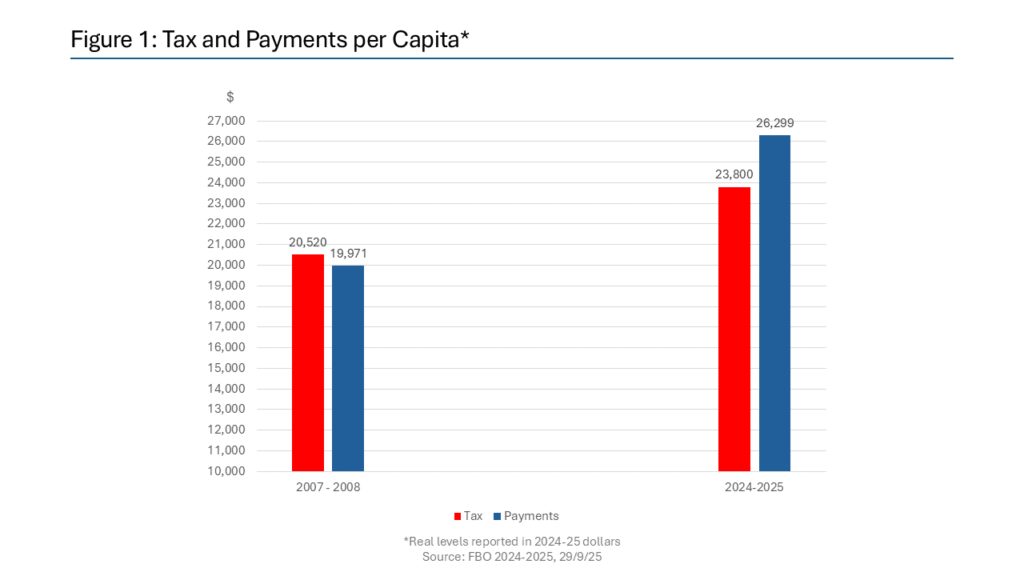
In constant dollars, since 2007, tax per person has risen around 16%- about 1% per year. The Government is now softening us up for more tax rises.
Over the same time, in constant dollars, Government spending has grown around 32%- about 2% per year since 2007. The difference between what Government gets from tax and what it spends is growing. Both are rising but spending is growing faster.
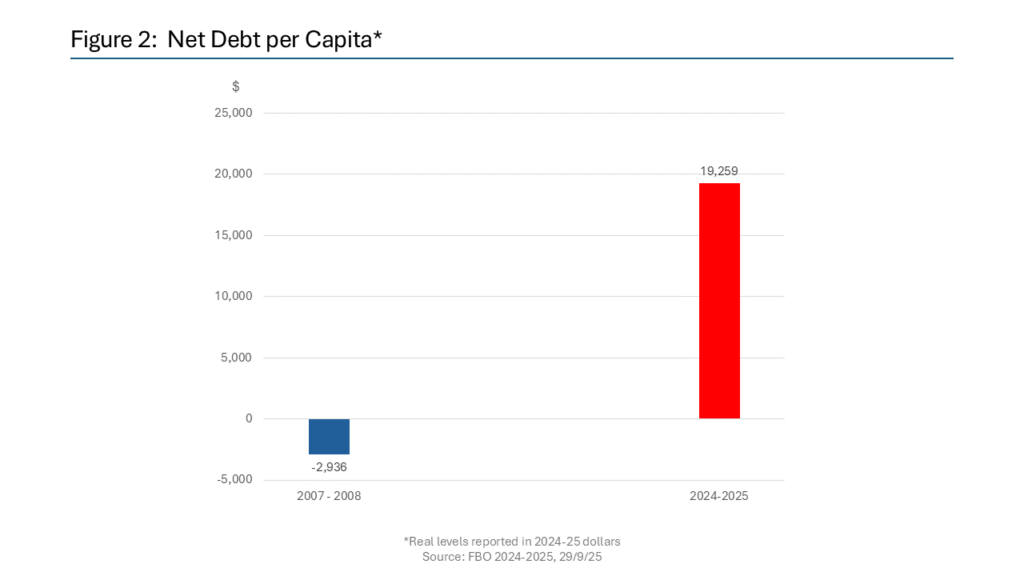
To pay for this massive spending the Government is borrowing more than ever. Twenty years ago, we had no net debt. Today net debt is just under $20,000 per man, woman, child, and baby.
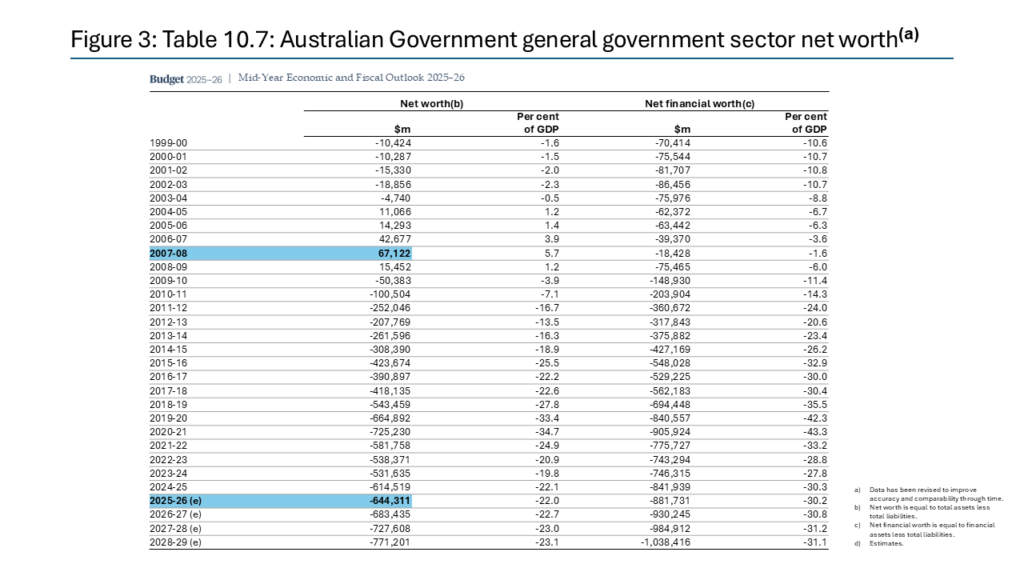
The widest measure of what the Government owes and what it owns is its net worth. It includes its debt, it includes all the whiz-bang assets the Government has spruiked in recent years like NBN and Snowy 2.0. It includes the Commonwealth’s only decent asset- the Future Fund. Despite all the fancy accounting the Government has not been able to hide one stark and sobering fact- the Australian Government has no net worth.
It used to have net worth, but over the last twenty years Government capital has run down $700 billion. That is undisputed. That is the run down in sovereign economic capital. It will particularly disadvantage the young.
We used to lead the pack on productivity growth. Now we trail. The U.S. economy is growing around 4% but inflation is contained because productivity is growing. Australia used to be able to do that. But with poor productivity inflation has broken out even though our economic growth is a paltry 2%. Our economic speed limit is much lower these days. That’s why interest rates went up three weeks ago. The spending binge is a big contributor.
Demographic Change
Big demographic changes are now upon us.
The natural increase in our population over the last 3 years was only 322,618. The net overseas migration was around 1.3 million- four times as much. In the last three years overseas migration contributed 80% of population growth. We are bringing in labour to compensate for low growth in natural population.
Our fertility rate is continuing to decline. In a generation’s time- around the 2050s- there will be more people dying than being born in Australia. In our society deaths will outnumber births.
Many have theories on what can be done to lift the fertility rate. Some say childcare, some maternity leave, some say cheaper housing.
There is no single reason for the decline in fertility so there is no one single answer. All western advanced societies have experienced declining fertility. Educational standards are higher in richer societies. Spending longer in tertiary education means women delay having children. Fertility declines the older you get.
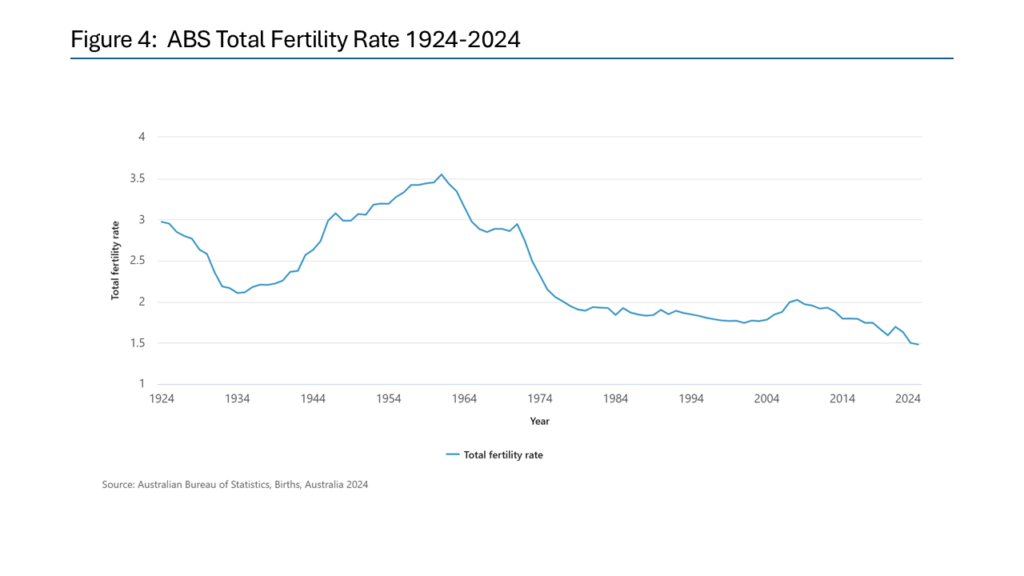
If you look at the declining fertility rate over time it has not been uniform. Fertility fell in the Depression, boomed in the post-war period, fell in the 1970s with the introduction of the contraceptive pill. But we have never been in this territory before. There has been a secular decline in the birthrate since the 1970s except for a short upturn around 2004.
How do we account for that?
In May 2004, the Government announced a universal lump-sum Maternity Payment of $3,000 (commonly known as the Baby Bonus) payable to every mother on the birth of a child. It didn’t just appear. It was part of our response to the Intergenerational Report which gave a careful explanation of the importance of children to society and the long-term cost of declining fertility rates. We started levelling with the public. The financial bonus was part of a suite of measures introduced as a response.
A new Government withdrew the universal payment in 2008 and bit by bit abolished the payment altogether. The birthrate resumed declining again
Demographers are very familiar with this episode. It was so unusual that people from other countries came to Australia to study it. Some academics came up with inventive reasons why the uptick occurred.
But recent rigorous academic research [ e61 Research Note number 31, 7/10/2025, ‘How Financial Incentives Shape Fertility in Australia”] has credited the Baby Bonus for arresting the fertility decline. The strongest response was in third births. The study concludes that Australian experience shows well designed incentives can have an effect, but it depends on “the design and targeting of the policy.”
That’s common sense. This is a case where design and targeting was done well.
I would add that having children requires some confidence about the future. We were confident about our prospects 20 years ago. That made a big difference.
Improving our prospects would make a big difference again.
And, it is hard not to think that a diet of climate catastrophism has made some people cautious about bringing children into the world. What sort of a future is there for children if global warming is going to end life as we know it? Climate catastrophists don’t like population increase. They believe people are a threat to the eco system.
I believe the success of the Baby Bonus policy was not so much the financial incentive but the larger public explanation behind it-that having children is important work and healthy for society.
It is not just an opportunity cost.
It is an opportunity benefit.
This is a very big issue for our future. Policymakers should talk about and explain it. No-one has done that in the last twenty years.
Our Decline
So why did Australia slip over the last generation?
Fixing deep-seated problems is likely to require patience and sustained effort. We live in an instantaneous on-demand world. Short term fixes are beguiling. Our Leaders lost long term focus.
Government programs have dramatically expanded. Much of it was haphazard, poorly designed, and wasteful. This expansion created new expectations and further demands.
We walked away from self-reliance as a public virtue. That has been a big change in the last twenty years.
You can see from the run up in public spending that people are more reliant on Government.
You can see from the run up in tax that it is getting harder to be independent.
Self-reliance and independence are out because big government is in.
It can take a long time for the results of an economic run-down to be fully felt, particularly if you start from a strong position.
But direction matters. You are either building better economic prospects or settling for worse. We settled for worse. Our prospects have declined. This is the legacy we are leaving for the young. Our country is still better than most, but it could have been so much better still.
To recover things we need first to understand what happened. Then we need to take action to fix it.
We did it a generation ago. We can do it again.